
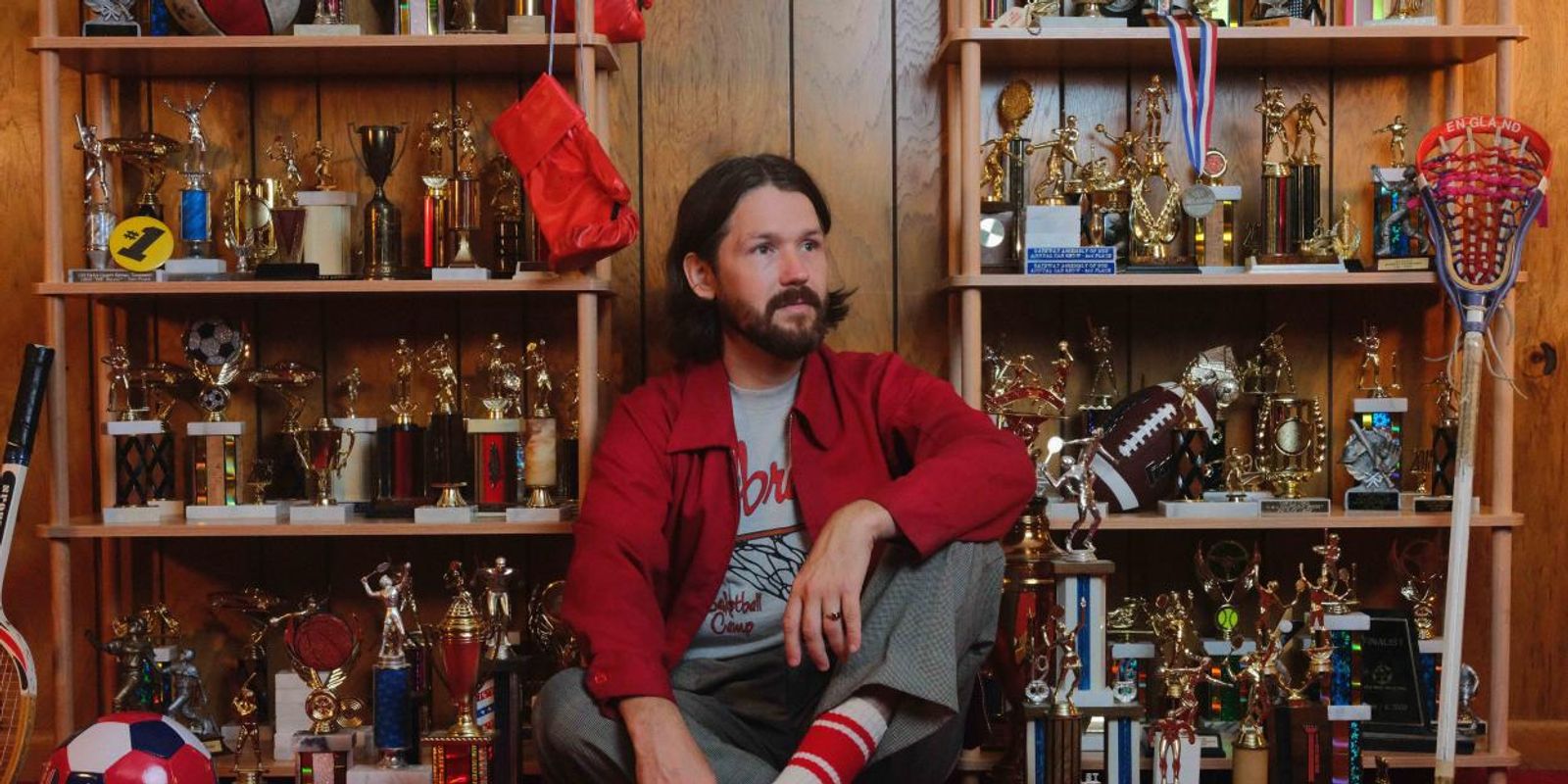
Kyle Ryan has never been the kind of musician who fits neatly into one genre.
Long before becoming a producer, songwriter, multi instrumentalist, and touring musician, Ryan was a kid in Lincoln, Nebraska discovering music through skate videos, basement shows, garage performances, and whatever records happened to find their way into his hands. Punk rock was an early obsession. NOFX, Bad Religion, Pennywise, Green Day, Nirvana, The Offspring, and Beck all became part of the musical world he was building for himself.
At the time, discovering music was a very different experience. There was no streaming service capable of delivering an endless catalog with a few taps. Ryan remembers growing up before the internet had become a central part of discovering music, meaning records often traveled through much narrower channels.
For Ryan, skateboarding was one of those channels.
Music discovered through skate videos could become something much bigger. A record could live inside a Discman for an entire year, becoming a soundtrack to a particular period of life. That early relationship with music helped shape the way Ryan still thinks about songs today. He is interested not only in what a song sounds like, but in the feeling that comes from discovering something unexpected.
That curiosity eventually took him far beyond punk rock.
Ryan attended Berklee College of Music, where he immersed himself in music theory and eventually tested out of the first four years of theory. While he loved learning the mechanics behind music, he also discovered that knowing too much about the rules could sometimes make creativity feel more mathematical.
Over time, Ryan learned how to use that knowledge without allowing it to control the creative process.
As a producer and songwriter, he often finds himself acting as what he describes as the “adult in the room.” His job is frequently to help artists find what they are looking for musically, whether that means suggesting a different chord, finding an unexpected harmonic direction, or simply knowing when to step back and let an idea develop.
At the same time, Ryan has deliberately tried to preserve the curiosity of the younger musician he once was.
He described learning the clarinet without even learning the names of the notes, instead focusing on the sounds themselves. For Ryan, there is something valuable about experiencing an instrument without immediately turning everything into theory. The limitations can actually become part of the creativity.
That philosophy has followed him throughout his career.
Ryan spent roughly a decade working with Kacey Musgraves, experiencing her rise from smaller performances to increasingly larger stages. One of his most memorable experiences came during the period surrounding Golden Hour. Musgraves brought Ryan in near the end of the recording process, where he contributed guitar parts, including a solo on “Velvet Elvis.”
The story behind that solo is a perfect example of Ryan’s instinctive approach to music.
Musgraves sent him the song, and while listening to it in his kitchen, Ryan began humming the guitar melody he imagined for the solo into his phone. That simple idea eventually became the part he played on the record.
His years with Musgraves also gave him a firsthand view of what happens when an artist’s career begins moving beyond what once seemed possible. Ryan remembers joining her when they were still playing relatively small shows and watching the audience grow. One moment that made the scale of the journey feel real came when they played a sold out show in London for roughly fifteen hundred people.
For someone who had once been playing small venues and coffee shops, seeing that kind of growth was surreal.
After leaving the road during the pandemic and becoming a father, Ryan began shifting his attention toward his own music. He had recorded songs privately over the years, but eventually decided that he wanted to make a record that he could actually put into the world.
That process became an exercise in letting himself be an artist rather than always approaching music as a producer.
His song “Cool” grew from an unexpectedly simple moment. Ryan stepped on his dog’s foot and immediately felt that familiar feeling of hurting someone you love without meaning to. From there, the idea expanded into something much larger about relationships, communication, and the ways people can hurt each other without always knowing how to explain what happened.
The song also became a laboratory for Ryan’s musical instincts.
He recorded it multiple times, experimenting with different arrangements and even incorporating clarinet before eventually finding the sound he wanted. He describes himself as a maximalist at heart, and “Cool” reflects that willingness to keep adding, removing, reshaping, and exploring until a song feels complete.
Ryan says he often does not fully understand what a song is about until he hears it back.
That discovery is part of what makes songwriting exciting for him. He may begin with a melody or a few words, return to the song weeks later, and eventually realize that the finished lyrics are revealing something he had been feeling without consciously knowing it.
That same personal approach appears in “Two of Us,” a song Ryan initially set out to write for his wife. Somewhere during the writing process, however, his daughter became part of the song as well.
The title remained “Two of Us,” but the meaning became something more complicated. Ryan was trying to write about his relationship with his wife while simultaneously experiencing the reality of becoming parents. Their daughter was always present, both literally and emotionally, turning what began as a love song for two people into a song about a family of three.
That mixture of sincerity and humor is an important part of Ryan’s approach to his new music. He says he enjoys the way artists such as John Prine can make listeners feel emotional while also making them laugh. He wanted some of that same balance to exist throughout his own record.
For Ryan, music has always been about discovery. Sometimes that means finding a strange chord progression. Sometimes it means hearing an unexpected influence from a band he has not listened to in fifteen years. Sometimes it means writing a song and only realizing what it means after the song is finished.
Now, with his own music finally making its way into the world, Ryan is approaching the next chapter with the same curiosity that shaped him as a young musician.
He describes the record as a “signal flare,” putting the music out into the world and seeing where it takes him.
After years of helping other artists find their sound, Kyle Ryan is finally giving himself the room to wander, experiment, and discover what his own music has been trying to say.