
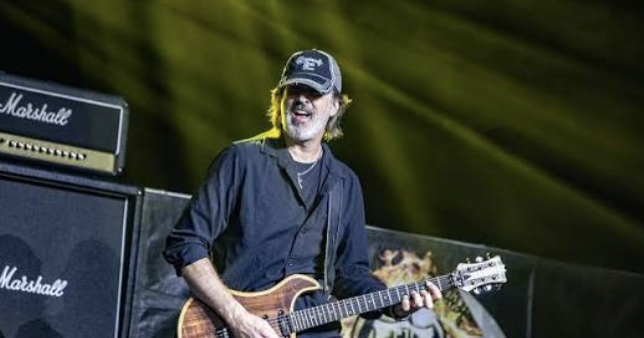
Firehouse guitarist Bill Leverty reflects on songwriting, musical influences, unforgettable moments, and the people who helped shape his career.
For Bill Leverty, music has always seemed to begin with something simple: a great idea.
Sometimes that idea is a riff. Sometimes it is a hook. Sometimes it is a song that simply needs to be brought to life.
As the guitarist and songwriter behind much of Firehouse's signature sound, Leverty has spent decades developing a recognizable approach to guitar playing—one built around memorable riffs, strong hooks, and songs that can immediately pull a listener in.
During a recent conversation, he offered a glimpse into the creative process behind that sound, the musicians who influenced him, and some of the moments throughout his career that still stand out.
When the Riff Comes First
One of the most recognizable elements of Firehouse's music is its guitar work, and Leverty's songwriting process often begins with the riff itself.
When the conversation turned to one of his songs, “You're Too Bad,” Leverty explained that the song started with its central riff and hook.
The phrase “You're too bad for your own damn good” became the starting point. From there, Leverty worked out a chord progression around the riff and sent the idea to CJ Snare, who developed it further.
The result was a song that came together remarkably quickly.
That process says a lot about how Leverty approaches songwriting: the guitar part does not simply sit underneath the vocal. It can be the thing that establishes the identity of the entire song.
The Era When the Riff Was King
Leverty also reflected on how guitar riffs have changed over the years.
When the conversation turned toward the evolution of rock music, he pointed to Nirvana as an example of a band that approached riffs differently from many of the hard-rock bands of the eighties.
He described Nirvana's riffs as having a different structure and presentation while still being immediately identifiable.
For Leverty, that evolution is part of what makes music interesting.
Rather than viewing different eras as completely separate, he sees music as something that continues to evolve.
“I like it all,” he said when discussing where music has gone and where it might go next.
That openness is also reflected in the musicians he names when talking about guitar playing.
When asked about some of his favorite riffs, Leverty chose “Bloodsucking Leeches,” an instrumental by the Dixie Dregs, and specifically pointed to Steve Morse's guitar work.
For him, a great riff does not have to fit neatly into one particular style. It simply needs to have something that makes you stop and listen.
The Night John Bon Jovi Walked Onto the Stage
One of Leverty's favorite career memories happened before Firehouse had even secured its record deal.
The band was playing at Beatty's Rock Garden in Winston-Salem, North Carolina, an outdoor club where Firehouse was performing before its breakthrough.
Their manager, Danny Francis, had previously worked as a tour coordinator for Bon Jovi during the Slippery When Wet era.
The band eventually got a tape to John Bon Jovi, who liked what he heard.
Then came the moment Leverty still remembers.
Bon Jovi came to see Firehouse perform—and John Bon Jovi actually joined the band onstage.
He and CJ Snare sang “Give Me Some Lovin'” together, trading verses while Leverty watched from the stage.
Leverty described it as one of his earliest true “pinch me” moments.
It was especially significant because it happened during the height of Bon Jovi's popularity.
For an up-and-coming band, suddenly sharing a stage with one of the biggest names in rock was the kind of moment that could make everything feel surreal.
Learning From Richie Sambora
The connection to Bon Jovi did not end with that night.
Leverty also developed a relationship with Richie Sambora, describing him as someone who became a genuine mentor.
After shows, Sambora would spend time talking with Leverty about songwriting, guitar tone, the music business, and other aspects of being a professional musician.
Leverty remembered going to Bon Jovi shows and spending time with Sambora afterward.
What stayed with him was not simply meeting a famous guitarist—it was the opportunity to learn from someone whose experience he respected.
Leverty described Sambora as a complete artist who had the ability to sing, write songs, and play guitar at a high level.
For a songwriter and guitarist, that kind of mentorship can be just as valuable as anything learned in a rehearsal room.
Feeling the Energy of an Audience
For all the attention that can be placed on guitar playing and songwriting, Leverty also emphasized the importance of the live experience.
When asked how he knows whether an audience is enjoying a performance, his answer was less about statistics or obvious reactions and more about energy.
He joked that he is often too busy looking down at his fingers and making sure they're doing what he wants.
But once he looks up, he can feel what is happening in the room.
“We're putting out energy and usually the audience is giving it back to us,” Leverty explained.
He described that exchange as a “circle of energy” between the band and audience.
Some nights, that connection is immediate.
Other nights can be more difficult.
But when the two sides connect, the band can walk offstage knowing they experienced something special together.
Reinventing the Set Without Losing the Songs
That same attention to the audience played a role in how Firehouse approached its shorter performances.
During the band's Disney performances, Firehouse played three sets per night. Leverty described the venue as having excellent equipment, lighting, and production, while also giving the band an opportunity to perform for different groups of people throughout the evening.
The shorter sets meant the band had to make decisions about which parts of its catalog could fit into the available time.
One solution was to combine three of Firehouse's major ballads into a medley.
The idea originally came from Don Barnes, who spoke with Leverty about the gig and suggested combining songs.
Leverty, Nate Peck, Michael Foster, and Alan McKenzie then worked out how the songs could transition from one to another while preserving the important hooks.
After performing the arrangement for the first time, the band went backstage and decided to keep it.
The audience reaction had answered the question for them.
It was a practical example of something Leverty seems to understand well: honoring the songs does not necessarily mean performing them exactly the same way every time.
Sometimes, keeping a song alive means finding a new way to present it.
Music That Calms Him Down
Behind the guitarist who spends his career performing onstage is someone who admits that music can also be a way to quiet his mind.
Leverty described himself as a nervous person and explained that he sometimes turns to music when he needs to calm down.
His go-to choice is Simon & Garfunkel's version of “Scarborough Fair.”
He specifically pointed to the waltz timing and the way the song gradually builds, describing the overall feeling of it as “zen.”
It is an interesting contrast to the music Leverty performs onstage.
The same musician known for driving rock guitar riffs finds a completely different kind of comfort in a quiet, slowly building folk song.
A Song for the World
When asked what song he would dedicate to the world in the current moment, Leverty chose a deceptively simple answer:
The Beatles' “All You Need Is Love.”
After decades of performing and songwriting, the answer reflects something that runs through much of Leverty's conversation about music.
The riffs matter.
The guitar tone matters.
The songwriting matters.
But ultimately, music is about connection.
That connection can happen between two musicians writing a song together, between a mentor and a young guitarist, between a band and an audience, or between a listener and a song that happens to reach them at exactly the right moment.
Carrying the Firehouse Story Forward
That idea of connection is especially relevant to the band's current chapter.
Leverty spoke warmly about performing alongside Nate Peck, describing him as his “brother” and emphasizing the bond Peck had formed with CJ Snare before Snare's passing.
Leverty explained that CJ and Peck had become close friends, speaking regularly and developing a strong relationship.
For Leverty, that history makes Peck's presence with Firehouse meaningful.
He described Peck as CJ's protégé and said that he feels the band is in good hands.
It is another example of the way Leverty talks about Firehouse—not simply as a collection of songs, but as a continuing story involving the musicians, friendships, influences, and experiences that have shaped the band over the years.
Still Looking Toward the Next Song
Bill Leverty's story is ultimately a story about staying curious.
From the early days of playing clubs in North Carolina to sharing a stage with John Bon Jovi, from learning from Richie Sambora to continuing to develop Firehouse's live show decades later, his career has been defined by music in motion.
The riffs may change.
The technology may change.
The venues may change.
The people onstage may change.
But the fundamental thing remains the same: finding a great musical idea and seeing where it can go.
And for Leverty, there still seems to be plenty of music left to discover.